
elea Highlights
elea and Lumea launch a unified pathology ecosystem
This month we announced a strategic partnership with Lumea, the U.S. leader in digital pathology solutions: a collaboration that reflects our growing international presence.
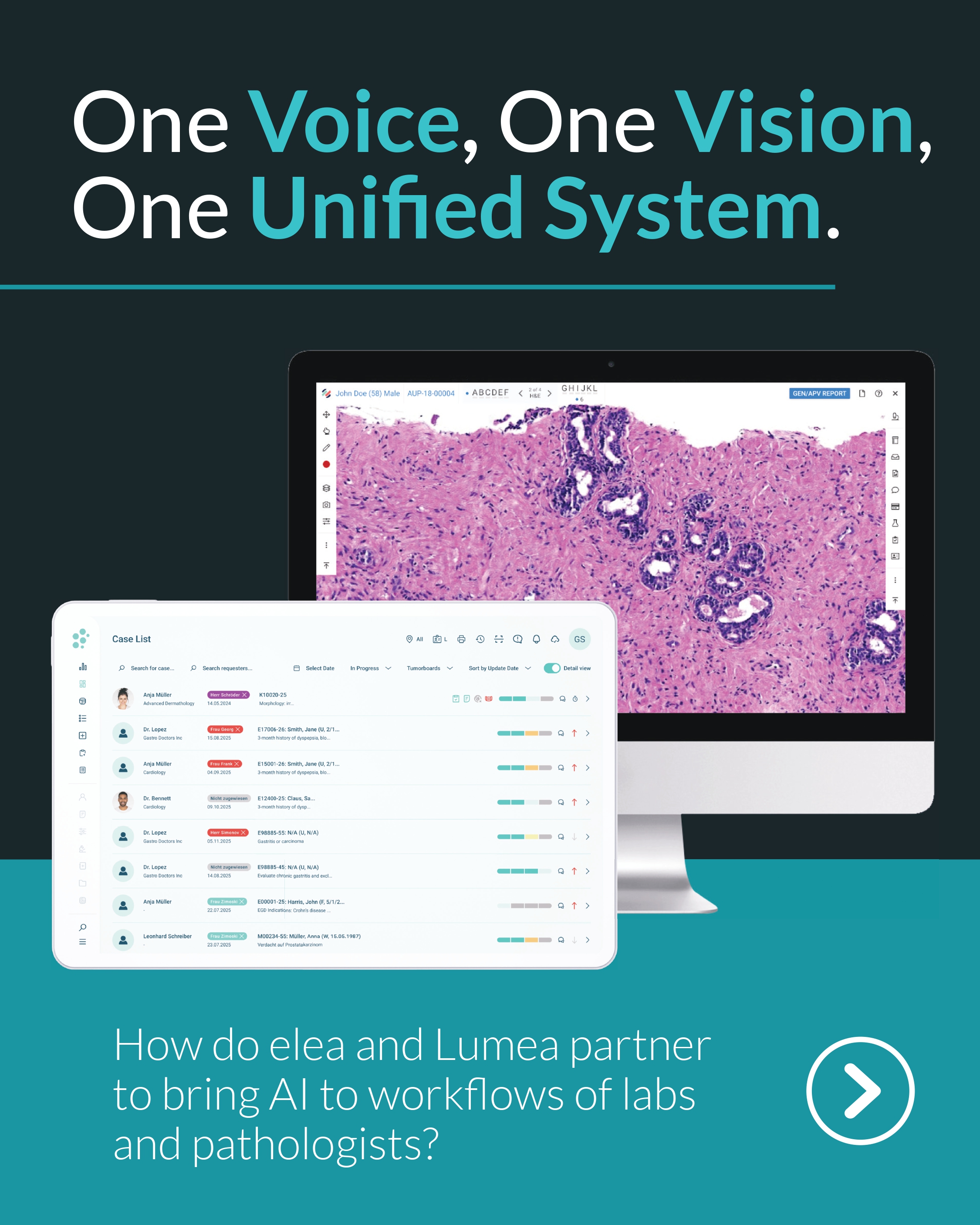
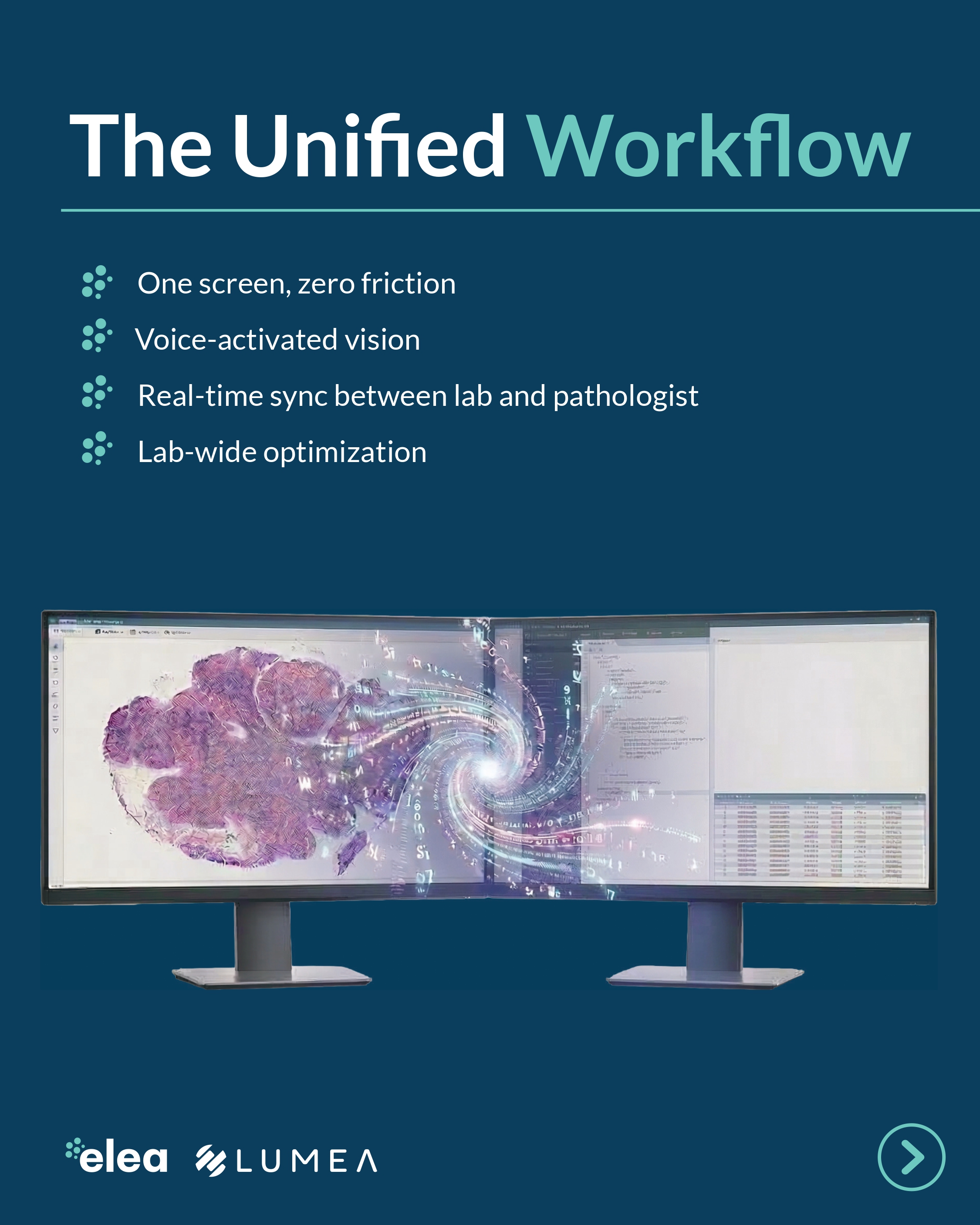
The partnership combines elea's AI-native agentic LIS with Lumea's FDA-cleared diagnostic viewer to create what we're calling a unified pathology ecosystem: one screen, one workspace, zero manual data re-entry. The traditional wall between data management and image analysis, a source of friction that every lab knows well, collapses into a single, coherent diagnostic environment.
In practice, this means pathologists can navigate complex cases using elea's voice-driven AI agent while the system simultaneously extracts structured data, prepares reports, and manages lab hardware in real time. No toggling between siloed tools. No duplicate entry. A workflow that anticipates what comes next.
Early results from initial implementations show meaningful reductions in the time from sample to diagnosis, allowing clinicians to initiate treatment significantly faster than with disconnected systems. As our CEO Christoph Schröder put it: the U.S. market doesn't need more integration projects. It needs a unified pathology ecosystem. That's what this partnership delivers.
elea featured in Smart in Media's Innovation Spotlight
This month, our CMO Sebastian Casu was featured as an expert in Smart in Media's Innovation Spotlight series, a sign that the conversation around AI in pathology is reaching well beyond the field itself.
The conversation addressed a question we hear constantly: where is AI actually creating value in pathology right now? Sebastian's answer was direct: it's in time. Not in headline-grabbing diagnostic breakthroughs, but in focused tools that handle documentation, workflow coordination, and repetitive administrative work, giving pathologists back the mental bandwidth for the work that genuinely requires their expertise.
The spotlight also pushed back on a persistent assumption in the field: that AI in pathology begins and ends with image analysis. A pathologist's daily challenges extend far beyond whether an algorithm can detect a tumor. Clinical history, prior results, imaging, and structured reporting are all part of the same diagnostic chain, and AI can support every step of it, but only when it is part of that chain, not layered on top of it.
At elea, our answer to these structural challenges is an AI-native LIS built directly into the core of the pathology workflow, not as an add-on, but as the foundation that makes all future AI tools work. AI that lives outside the systems pathologists already use will always require an extra step, an extra screen, an extra decision about when to engage it. That friction accumulates. It limits adoption, limits impact, and ultimately limits value. AI that is deeply embedded, by contrast, supports the work without interrupting it, present at every step of the diagnostic chain, from documentation and coding to lab coordination and report release, without demanding that teams change how they work to accommodate it. That depth of integration is what separates a useful tool from a transformative one.
The goal is a pathology environment where pathologists simply do what they do best: diagnose.

In the Press
"Beyond Image Analysis" published in The Pathologist
We're proud to share that our CMO Sebastian Casu and Richard Gruner, Chief of Staff, published a piece in The Pathologist this month titled "Beyond Image Analysis: How AI is Reshaping the Pathology Workflow."
The article takes a question that rarely gets enough attention: What happens to all the work surrounding the diagnosis? and answers it with a real-world case study from a major anatomic pathology institute in Bremen, Germany.
Before introducing elea's AI-native LIS, the institute operated with a conventional setup: dictations transcribed by staff, diagnostic content stored as free text, and billing or registry data manually extracted from narrative reports. A robust model, but one that struggled to scale. A transcription backlog had become a recurring pressure point, and downstream processes depended on information that was hard to reuse.
What changed wasn't the diagnostic step. Pathologists kept dictating. But the system evolved that dictation from a documentation bottleneck into a structured data interface, automatically extracting diagnostic codes, controlling lab hardware, and preparing reports for review in seconds. The transcription backlog resolved. Turnaround times dropped. And the time regained went back to clinical work.
The broader lesson: AI doesn't need to touch the diagnosis to transform a pathology department. Sometimes the greatest impact is in making the work around it sustainable.
.JPG)
Signals from the field
elea at USCAP 2026 in San Antonio, TX
Few conferences bring the full spectrum of pathology together the way USCAP does, and this year, Christoph Schroeder, Sebastian Casu, and Richard Gruner were there representing elea. Their focus was as much on listening as on presenting: what is actually happening inside labs right now, where the real bottlenecks are, and what pathologists genuinely need from the infrastructure around them.
The conversations at USCAP reinforced what we keep hearing across markets: teams want AI-assisted reporting, better lab automation, and fewer manual handoffs between systems. Progress in digital pathology doesn't happen in slide decks, it happens in those honest exchanges about real workflows and real constraints.
USCAP was also where we introduced the Lumea partnership to the broader pathology community in person for the first time: a collaboration that brings image analysis and case management into one connected workspace, eliminating the back-and-forth between systems that slows labs down.
elea at the 2nd PATHORA Symposium on Bladder Cancer in Reutlingen
Carlo Sirna and Dominik Maucher attended the 2nd PATHORA Symposium on Bladder Cancer in Reutlingen, joining leading experts from pathology and urology following the invitation of Prof. Dr. med. Sven Perner.
What makes this kind of symposium particularly valuable is the depth of exchange between clinical practice and pathology, conversations where diagnostics, structured data, and digital workflows aren't abstract concepts but daily realities. We're grateful for the invitation and proud to have been there as a sponsor and exhibitor.
Read of the Month
"Digital Pathology: Who's Leading?" The Pathologist, March 2026
A timely piece from The Pathologist this month maps where digital pathology adoption actually stands, and what's holding it back. The analysis is grounded and worth reading in full, but one thread runs through the entire piece: the labs moving fastest are the ones that have solved the integration problem.
Pathologists consistently emphasize the importance of interoperability and workflow integration as a prerequisite for meaningful AI adoption, not an afterthought. The article also notes that more recently, some laboratories are evaluating scanners, workflow systems, and AI platforms simultaneously to support faster implementation, rather than in disconnected stages. That shift in purchasing behavior reflects a broader recognition: fragmented adoption creates fragmented results.
What the article describes as the emerging challenge is exactly what elea was designed to address: a single, AI-native system that connects data, documentation, devices, and downstream processes from the start, rather than stitching them together after the fact.

What's Coming Next?
We'll be at Histologica in Oberhausen for in-depth exchanges with the German-speaking pathology community, and at the Executive War College 2026 in New Orleans, where lab and pathology leaders discuss the operational realities shaping the field.